Damascus nakiri knives
The nakiri knife is the vegetable knife par excellence: its straight, rectangular blade meets the board along its full length with every cut. That's how you slice cucumber, leeks and cabbage cleanly without the slices sticking together. Here you'll find our damascus steel nakiri knives.
3 products
Guide
Damascus nakiri knives
What is a nakiri knife?
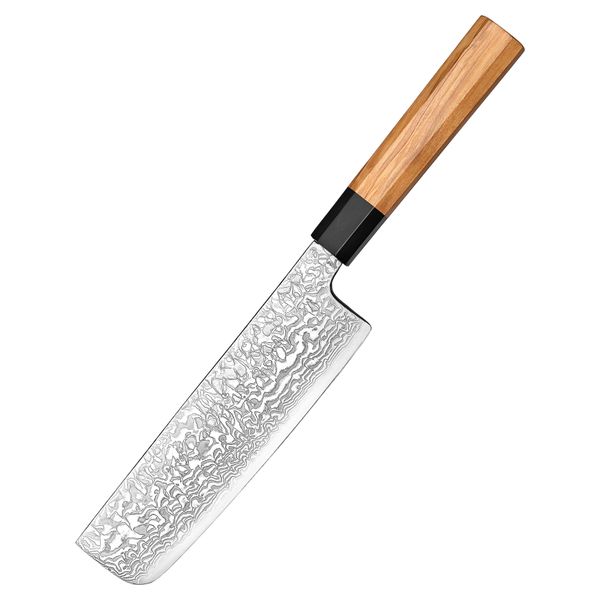
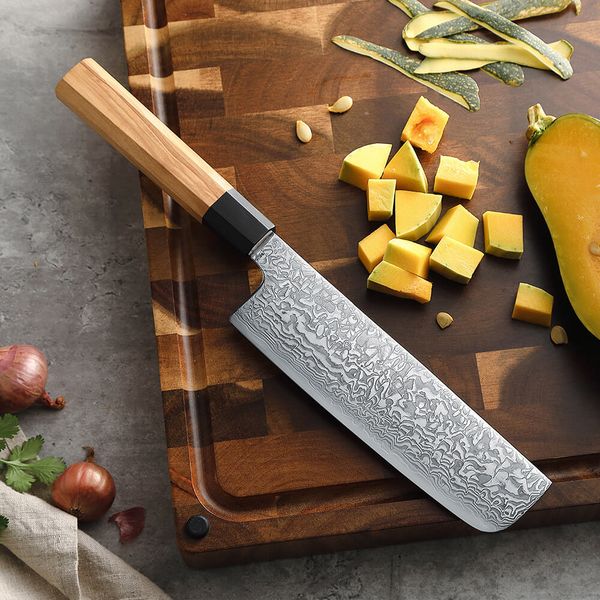
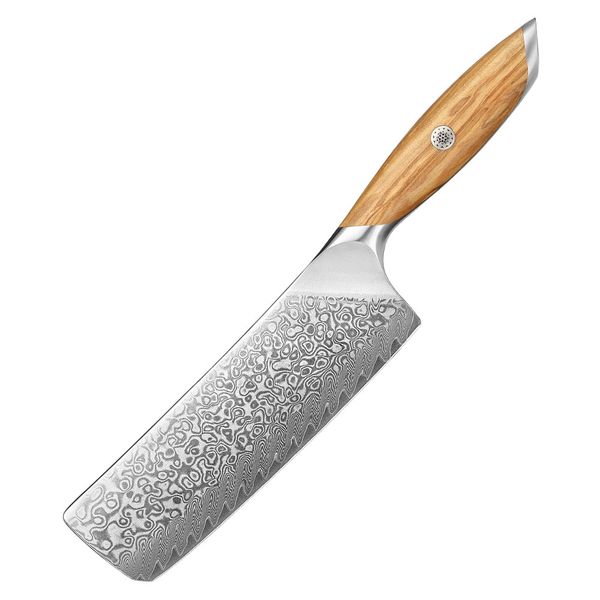
The nakiri is a knife shape from Japan designed entirely for vegetables. The name roughly means "vegetable cutter". Typical features are the rectangular blade, the straight edge without a curve and the blunt, square tip. Our nakiri knives are modelled on this design and have a damascus steel blade.
What is a nakiri used for?
- Fine slices: cucumber, radishes, courgettes or carrots. Because the whole edge meets the board at once, the slices don't stay joined like an accordion.
- Dicing and chopping: onions, celery and peppers are diced in no time with straight downward cuts.
- Cabbage and salad: white cabbage for coleslaw or pointed cabbage in fine strips.
- Herbs: finely chop parsley or coriander without bruising them.
- From board to pan: the tall blade doubles as a scoop for what you've cut.
For meat, fish and anything with bones or a hard shell, use a different knife. The nakiri is a specialist, and that's exactly its strength.
Nakiri vs santoku: what's the difference?
The santoku knife has a slightly curved edge and a tip. That makes it more versatile, and it cuts meat and fish too. The nakiri has a completely straight edge and no tip. With vegetables it's even more precise, because every cut goes right through to the board. If you cut a lot of vegetables or cook vegetarian, the nakiri often becomes your favourite knife. Many people combine both or pair the nakiri with a chef's knife.
How to cut with a nakiri
Because the edge is straight, you don't rock it. Guide the knife with a light forward and downward movement, or cut straight down. The fingers of your other hand rest curled on the vegetable, and the blade glides along your knuckles. Avoid levering and twisting on the board, so the fine edge doesn't suffer.
What to look for when buying
- Blade length: 16 to 18.5 cm is standard, long enough for cabbage, handy enough for onions.
- Blade height: around 5 cm gives your knuckles room and turns the knife into a practical scoop.
- Weight: a slightly heavier nakiri drops through carrots and squash almost by itself; a lighter one is nimbler with herbs.
- Hardness: our nakiris are 60 to 62 HRC and stay sharp for a long time.
Our nakiri knives at a glance
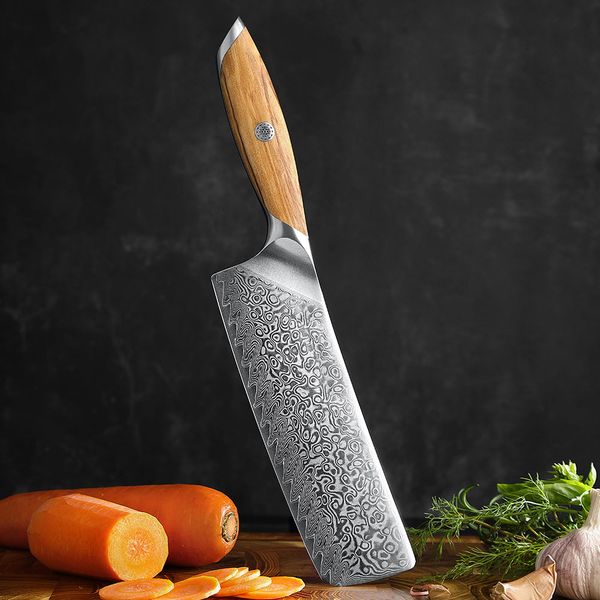
- KAYA: 18.5 cm blade with 67 layers around a hard steel core, olive wood and buffalo horn handle.
- ORIBU: 18.5 cm blade of 73-layer damascus powder steel, especially tall at 59 mm, olive wood handle.
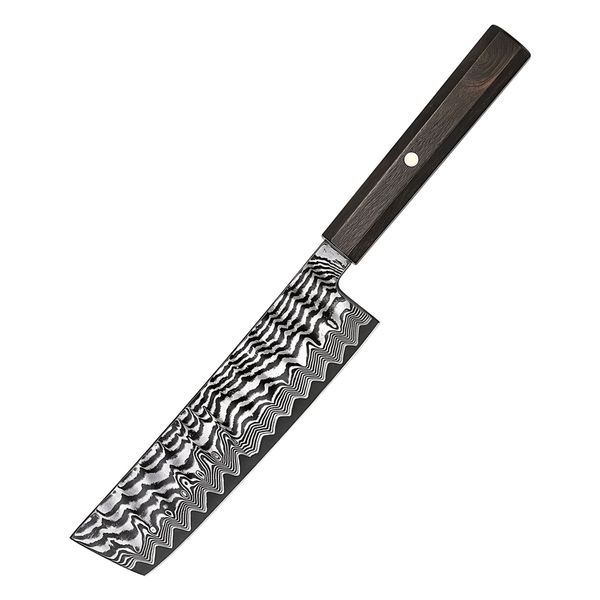
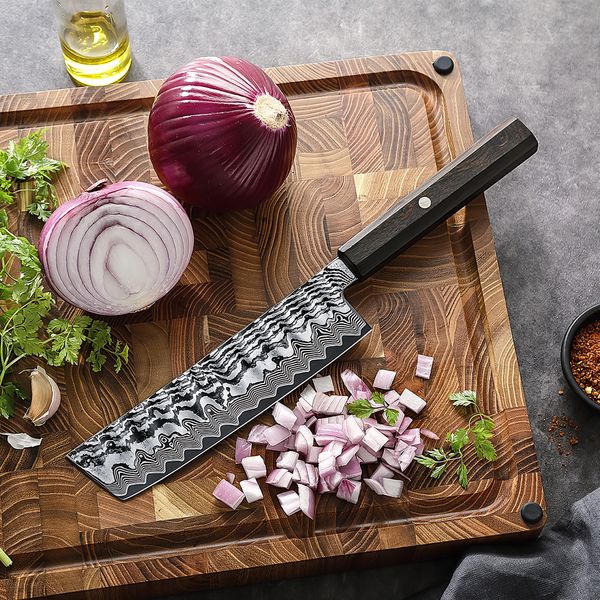
- NAMI: blade of around 18 cm with a hammered, wavy surface and an octagonal ebony handle.
Sharpening and care
The straight edge is especially easy to sharpen on a whetstone: hold the blade at about 15 degrees and draw it evenly along its full length. Cut on wood or plastic, wash the knife by hand and dry it straight away. With us you get a 30-day money-back guarantee and a 5-year warranty on every knife.
Frequently asked questions
What is a nakiri knife good for?
For vegetables and herbs: fine slices, dice and strips. Thanks to the straight edge, every cut goes cleanly through to the board.
What's the difference between nakiri and santoku?
The santoku has a slightly curved edge and a tip, making it more versatile. The nakiri has a straight edge without a tip and is even more precise with vegetables.
Can I cut meat with a nakiri?
Soft boneless meat is fine, but that's not what it's made for. For meat and fish, a santoku or chef's knife is the better choice.
How do you cut properly with a nakiri?
Without rocking: with a light forward and downward movement or straight down. The fingers of your guiding hand stay curled, and the blade glides along your knuckles.
How do I sharpen a nakiri?
On a whetstone at around 15 degrees per side. With the straight edge it's especially easy, because you don't have to follow a curve.
What's the difference between usuba and nakiri?
Both are vegetable knives with a rectangular blade. The usuba is single-bevelled and mainly intended for professionals. The nakiri is double-bevelled, which makes it much easier to use every day for right- and left-handers alike.
What is a damascus nakiri knife?
A nakiri with a damascus steel blade: many layers of steel, usually around a hard core. The core provides the sharpness, the layers the typical pattern. All our nakiri knives are damascus knives.