Damascus chef's knives
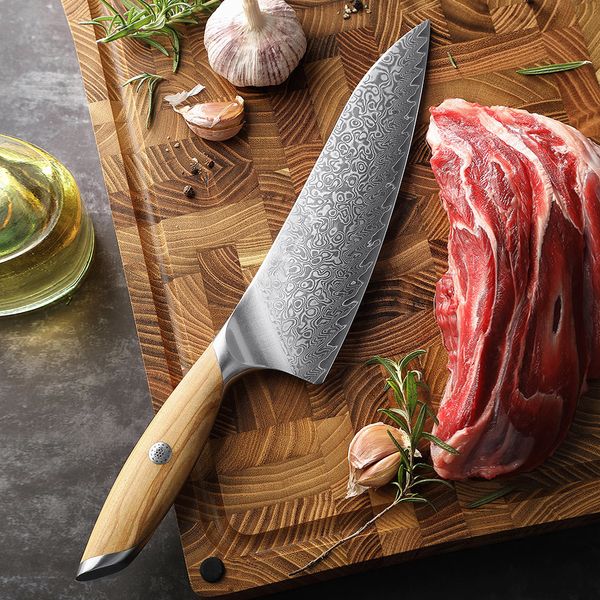
The chef's knife is the most important knife in your kitchen. With its long, sturdy blade you slice, chop and dice vegetables, meat and herbs. Our chef's knives have damascus steel blades of 60 to 62 HRC and stay sharp for a long time.
2 products
Guide
Damascus chef's knives
What is a chef's knife?
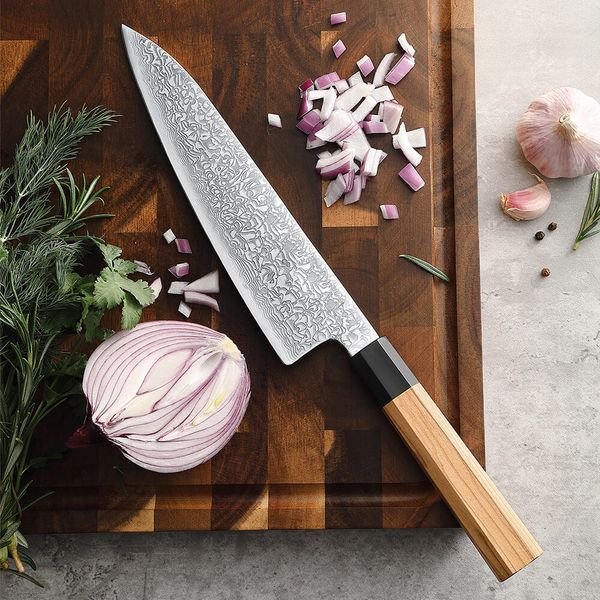
A chef's knife has a blade of around 20 cm that curves gently towards the tip. This curve makes the rocking cut possible: the tip stays on the board while the rear of the blade rises and falls, ideal for herbs, onions and garlic. The tall blade keeps your knuckles off the board and scoops up what you've cut.
Chef's knife or cook's knife: is there a difference?
No, both terms mean the same knife. "Cook's knife" and "chef's knife" are used interchangeably. They always refer to the large main knife for almost all cutting jobs.
Chef's knife, santoku or bunka: which suits you?
- Chef's knife: long, curved blade, perfect for the rocking cut and large quantities.
- Santoku knife: shorter and taller, with a straight edge, very handy, especially for vegetables.
- Bunka knife: straight edge with an angled, pointed tip, precise for fine work.
If you like to cut fast and a lot, the chef's knife is your first choice. If you prefer something more compact, go for the santoku.
What to look for when buying a chef's knife
- Blade length: 20 to 21 cm is ideal for most hands. Shorter blades are nimbler; longer ones cut large pieces in one stroke.
- Hardness: from 60 HRC the edge lasts much longer than on ordinary knives.
- Bevel: a fine bevel of around 15 degrees glides effortlessly through tomatoes and onions.
- Balance: the balance point should be close to the handle so the knife sits steadily in your hand.
- Handle: wood such as olive or ebony feels warm and grippy; G10 is especially low-maintenance.
Our chef's knives at a glance
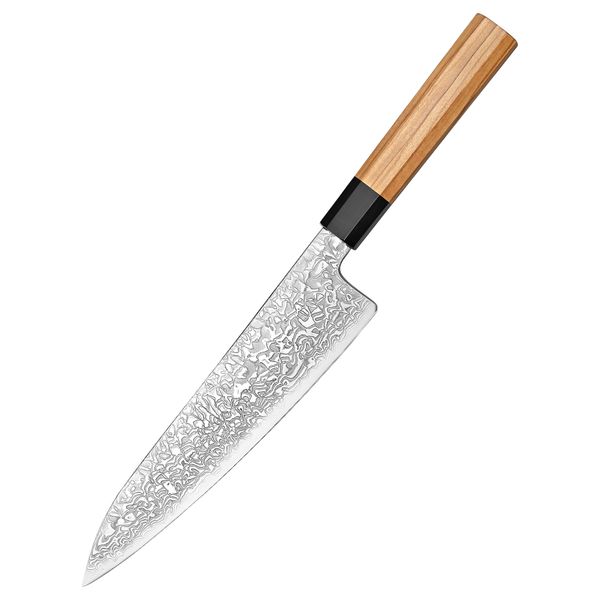
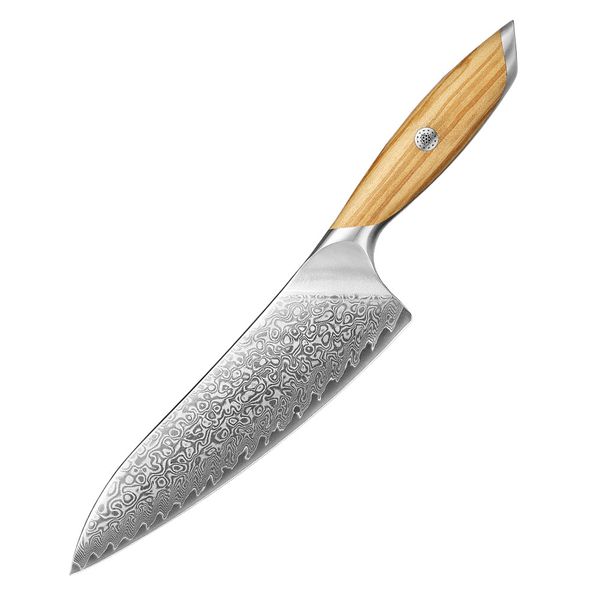
The KAYA chef's knife combines 67 layers of damascus steel with an angular olive wood and buffalo horn handle, hardened to 60 ± 2 HRC. The ORIBU chef's knife has a blade of 73-layer damascus powder steel and an olive wood handle with individual grain. If you like a straight edge with a tip, the bunka knives in the NAMI and HIIRO series offer an alternative with their own character.
How to cut properly with a chef's knife
Hold the knife where the handle meets the blade, with your thumb and index finger gripping the sides of the blade. Your other hand guides the food in a claw grip: fingertips tucked in, knuckles against the blade. That way you cut quickly and safely.
Care and sharpness
Wash your chef's knife by hand and dry it straight away. Cut on wood or plastic and resharpen the blade every few months on a whetstone with 1000 and 3000 grit. That way it stays sharp for years.
Professional chef's knife: what makes a quality chef's knife
You can recognise a professional chef's knife by its hard, thin blade, fine bevel and good balance. Our high-quality chef's knives are 62 HRC with a bevel of about 15 degrees per side. The blade shape with a gently curved edge matches the classic chef's knife shape, also common on the gyuto, the Japanese counterpart to the European chef's knife.
Japanese-style chef's knives
Anyone looking for a Japanese chef's knife is usually looking for a thin, hard and very sharp blade. That's exactly what our damascus steel chef's knives, inspired by Japanese knives, offer, with handles of olive wood and buffalo horn or pure olive wood. The santoku knife and bunka knife are good additions. For the grill and campfire there's also an outdoor chef's knife in santoku style.
We don't award our own test seals, and we don't call ourselves a "test winner". You're the best judge of whether a chef's knife suits you: with our 30-day money-back guarantee you can try it out at your leisure in your own kitchen.
Frequently asked questions
What blade length is ideal for a chef's knife?
For most people 20 to 21 cm is ideal. It handles everything from chopping herbs to squash. Smaller hands or small kitchens often get on better with a santoku of around 17 to 18 cm.
Is a damascus chef's knife better than a normal one?
What matters is the steel in the core. Our damascus chef's knives have a hard core of 60 to 62 HRC, so they stay sharp longer than ordinary knives. The damascus layers protect the core and give each blade its own pattern.
Chef's knife or santoku: which is better for beginners?
Both are good all-rounders. The chef's knife is especially suited to the rocking cut and large quantities; the santoku is shorter and handier. If you're unsure, start with the santoku.
How do I sharpen a chef's knife properly?
Ideally on a whetstone: first shape the edge with 1000 grit, then finish with 3000 or finer. Keep an angle of about 15 degrees. Ceramic honing rods are good for a quick touch-up in between.
What is a chef's knife used for?
For almost everything on the board: dicing vegetables, rock-chopping herbs, cutting boneless meat and fish. The long, curved edge makes it the ideal knife for the rocking cut and large quantities.
How do I sharpen, hone and restore a chef's knife?
To sharpen, use a whetstone and hold the blade at about 15 degrees: that's how you make a blunt chef's knife properly sharp again. Honing on a ceramic rod realigns the edge in between and extends the time until the next sharpening.