Damascus bread knives
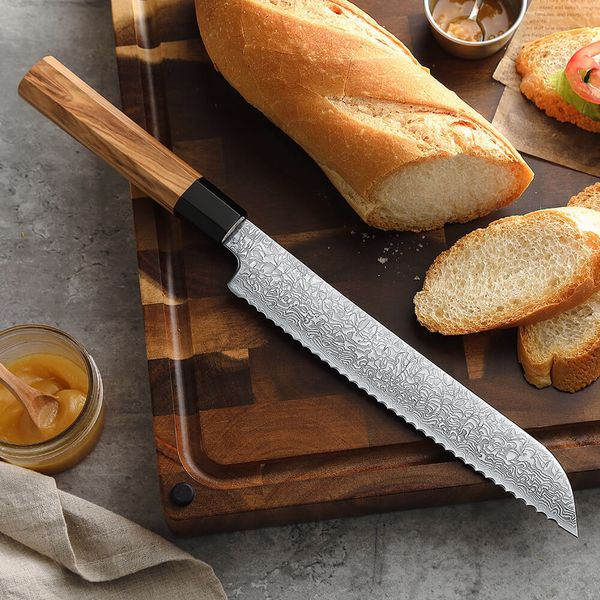
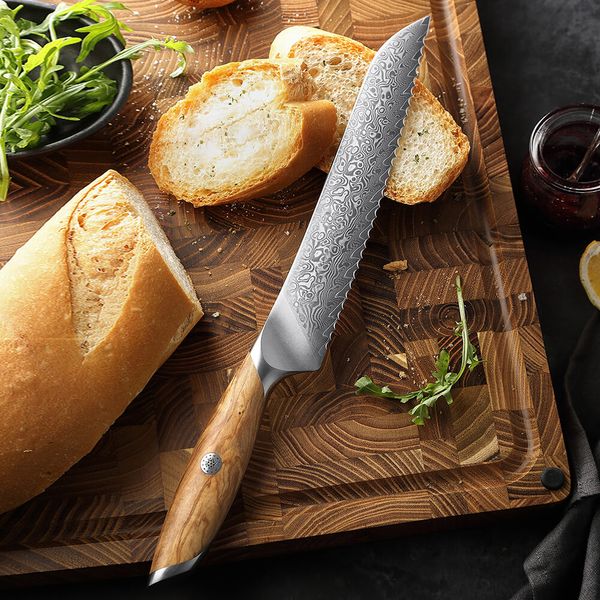
A good bread knife glides through a crisp crust without squashing the soft crumb. Our bread knives have a long damascus steel blade with a serrated edge, for sourdough, baguette and sandwich loaves as well as tomatoes or a roast with crackling.
2 products
Guide
Damascus bread knives
What makes a good bread knife
The serrated edge. The teeth bite into the crust immediately and saw through with little pressure. The crumb stays light and there are hardly any crumbs.
The length. The blade should be longer than your loaf is wide, so you can cut in long, steady strokes. Our bread knives measure 21.5 and 22 cm, enough for large loaves.
The hardness. At 62 HRC the teeth stay sharp for a long time. A soft bread knife quickly rounds off the points of the serrations and then tears rather than cuts.
The handle. Hard crusts need a bit of force. A handle that sits firmly and securely in the hand makes cutting easier and safer.
Choosing a bread knife: what to look for
When you compare bread knives, these points are worth a closer look:
- Cutting a hard crust: a good knife goes through the crust of a sourdough loaf without slipping.
- Soft crumb: fresh white bread or brioche shouldn't get squashed.
- Even slices: a long, straight blade helps you avoid cutting at an angle.
- Balance: the knife shouldn't be blade-heavy, so you can guide it in a relaxed way.
- Service: with us you get a 30-day money-back guarantee and a 5-year warranty on every knife.
We don't award our own test seals. Our customers rate the knives directly in the shop: you'll find the reviews on every product page.
Not just for bread
A serrated edge excels wherever a firm surface meets a soft interior: tomatoes, peppers, pineapple, melon, citrus fruit, sponge bases or a roast with crisp crackling. For almost everything else in the kitchen, reach for a straight-edged knife like the santoku knife or the chef's knife.
Our bread knives at a glance
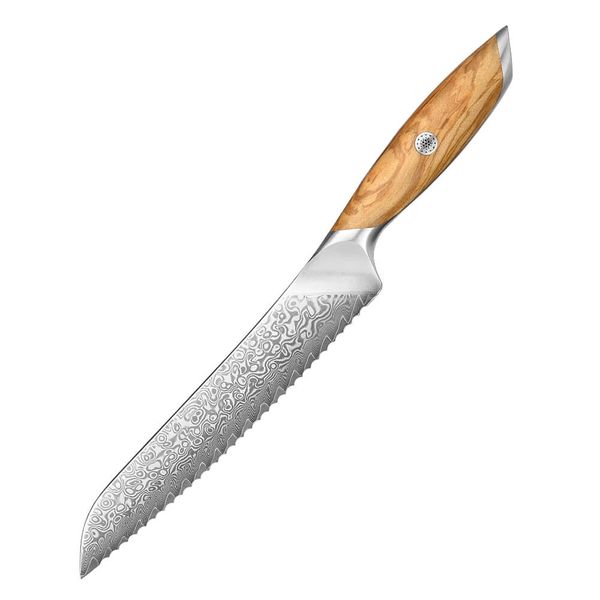
- KAYA: 22 cm blade with 67 layers around a hard steel core, olive wood and buffalo horn handle.
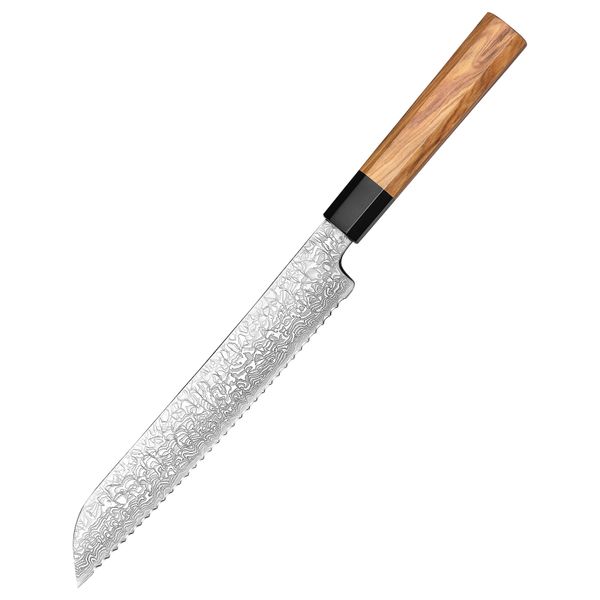
- ORIBU: 21.5 cm blade of 73-layer damascus powder steel with an olive wood handle.
Sharpening a bread knife
You need to sharpen a bread knife far less often than a straight-edged knife, because the teeth barely touch the board. If it does lose its bite, use a thin, round ceramic or diamond rod. Place it in each serration in turn on the bevelled side and draw it through a few times at the angle of the bevel. Remove the fine burr on the back with one light, flat stroke over a fine stone. If you'd rather not do it yourself, take the knife to a sharpening service.
Care
Wash the bread knife by hand, dry it straight away and store it in a block, on a magnetic strip or with a blade guard. Crumbs in the teeth come out with a soft brush. A knife set that includes a bread knife is also a good basic kit if you want several knives from one series.
The best bread knife for you
You can recognise a high-quality bread knife by its long blade, hard steel and a serrated edge that grips without tearing. A professional bread knife doesn't have to be expensive, but it does have to stay sharp, otherwise it squashes the crumb. With a good bread knife and a kitchen knife for everything else, you're ready for almost anything. We don't award our own test seals, and we don't call ourselves a "test winner". You're the best judge of whether a bread knife suits you: with our 30-day money-back guarantee you can try it out at your leisure in your own kitchen.
Frequently asked questions
How long should a bread knife be?
The blade should be longer than the loaf is wide. For most loaves 20 to 22 cm is ideal; for small loaves and baguettes, 19 cm is enough.
Can you sharpen a serrated bread knife?
Yes. With a thin ceramic or diamond rod you sharpen each serration individually on the bevelled side. Alternatively, a sharpening service can do it. It's rarely necessary, though.
Which bread knife is best for a hard crust?
A long knife with hard steel and pronounced serrations. Our bread knives are 62 HRC and cut through even a dark-baked sourdough crust.
Do I need a bread knife with a slicing guide?
A guide helps if you always want slices of exactly the same thickness. With a long, sharp blade and steady strokes you'll get even slices without one, and the knife stays more versatile.
Can the bread knife go in the dishwasher?
Please don't. Heat and detergents damage the steel and handle, and the teeth get blunt in the basket. A quick rinse by hand and a dry is all it needs.